The Short Answer
A website discovery phase is a structured period of research, analysis, and planning that happens before any design or development work begins. It’s the process of figuring out what you actually need, why you need it, and how it should work, so that the project you build is the project you should have built. It matters because skipping it is the single most reliable way to blow your budget, miss your deadline, and end up with a website that doesn’t perform.
That might sound dramatic, but across every project we’ve worked on at NexusBond, the pattern holds. Teams that invest in proper discovery before committing to a build consistently deliver better outcomes. Teams that rush past it consistently run into the same problems: scope creep, stakeholder disagreements surfacing mid-build, unexpected technical constraints, and a finished product that somehow doesn’t quite match what anyone had in mind.
What Actually Happens During Discovery
The word “discovery” gets thrown around loosely in the web industry. Some agencies use it to mean a single kickoff workshop. Others treat it as a months-long research engagement. The useful definition sits somewhere in between: discovery is the work required to turn a vague business objective into a validated, detailed project scope that everyone involved understands and agrees on.
In practical terms, a well-run discovery phase typically covers several distinct areas of investigation.
Business and Stakeholder Alignment
This is where you establish what the website actually needs to accomplish for the business, not just what it needs to look like. It involves interviewing key stakeholders, understanding commercial goals, identifying success metrics, and, critically, surfacing disagreements early. In our experience, every organisation with more than three stakeholders involved in a website project has at least one fundamental disagreement about what the site should prioritise. Discovery is where you find that disagreement and resolve it, rather than letting it derail the project during development when changes cost ten times more.
A typical stakeholder alignment process will uncover things like: the sales team wants the site to generate qualified leads, the CEO wants it to signal credibility to investors, and the marketing director wants it to rank well for a specific set of keywords. These aren’t necessarily conflicting goals, but they require different design decisions and content strategies. Without discovery, you end up trying to serve all three implicitly, which usually means serving none of them well.
User Research and Audience Analysis
Understanding who will use the website, and what they need from it, is foundational work that shapes everything from information architecture to page layout. This doesn’t have to mean commissioning a six-figure ethnographic study. Practical user research during discovery might include reviewing existing analytics data, conducting 5-10 user interviews, analysing search console data to understand what people are already looking for, and reviewing competitor sites to identify gaps and opportunities.
The goal is to build a clear picture of your primary audience segments, their key tasks on the site, and the decision-making journey they go through. For a B2B company, this might mean mapping out how a procurement manager evaluates your services versus how a technical decision-maker evaluates your capabilities. These are different people with different needs, and the site needs to serve both.
Content Audit and Strategy
Content is where most website projects quietly fall apart. Teams focus heavily on design and technology decisions during planning but treat content as something that will “get sorted out later.” Discovery is your opportunity to audit what content you have, what’s performing, what’s missing, and what needs to be created from scratch. A content audit during discovery typically reveals that 30-40% of existing site content is outdated, redundant, or actively unhelpful. Knowing this before you begin design work prevents the common scenario where beautiful page templates sit empty for months because nobody accounted for the content creation effort.
Technical Assessment
If you’re redesigning an existing site or migrating platforms, discovery includes a thorough review of your current technical environment. This covers your existing CMS, integrations with CRM or marketing automation tools, hosting infrastructure, third-party dependencies, SEO considerations like URL structures and redirect requirements, and any compliance or accessibility obligations. Technical discovery prevents the “we didn’t know about that” moments that add weeks to timelines and thousands to budgets. Finding out mid-build that your CRM integration requires a custom API connector is a very different situation from knowing that on day one and planning accordingly.
Competitive and Market Analysis
Looking at what your competitors and peers are doing with their websites isn’t about copying them. It’s about understanding the baseline expectations of your audience and identifying opportunities to differentiate. During discovery, a competitive review examines things like how competitors structure their service pages, what conversion mechanisms they use, how they handle social proof and case studies, and where their user experience falls short. This gives you a realistic benchmark for what “good” looks like in your market and helps you make informed decisions about where to invest effort.
What Discovery Produces
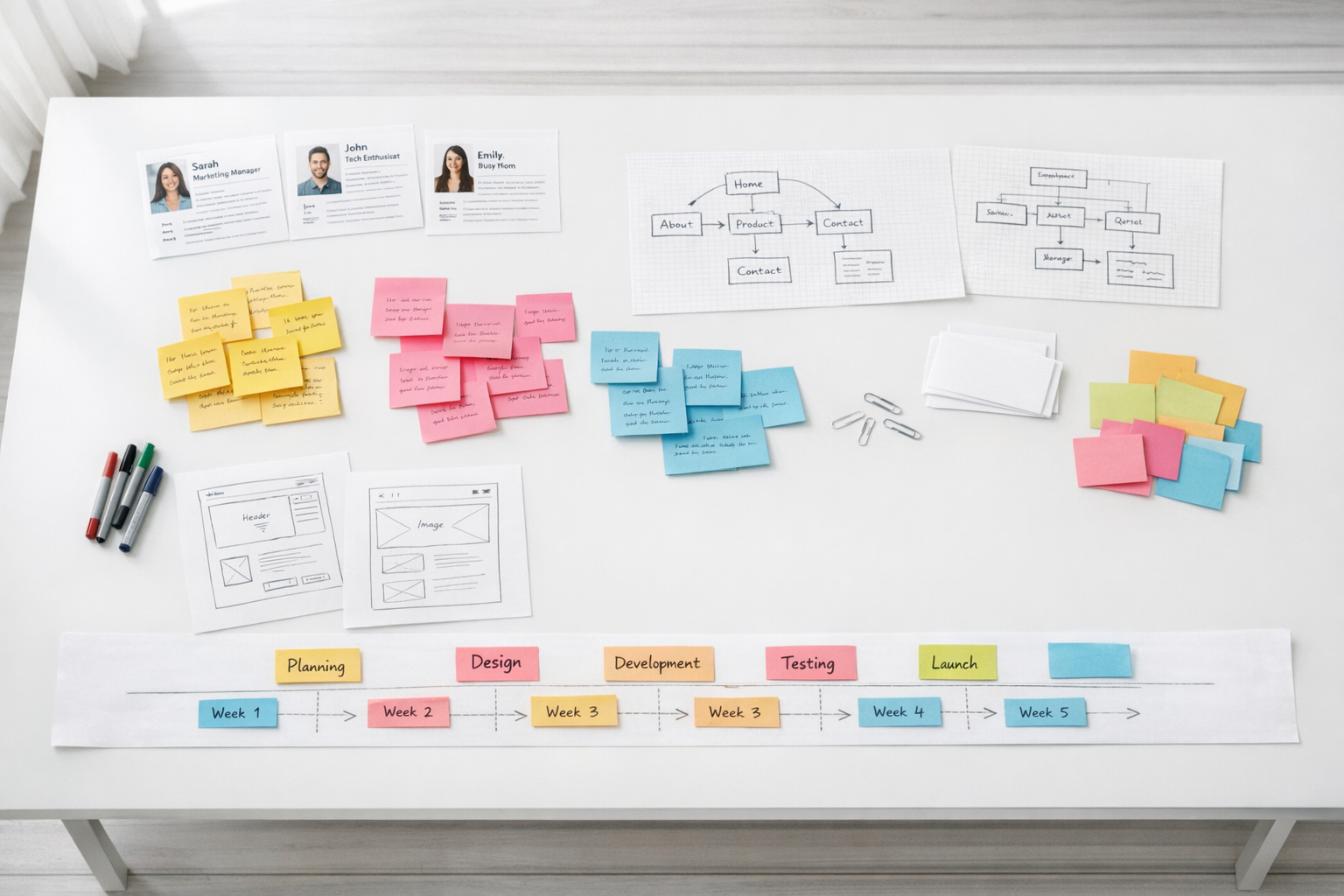
A discovery phase isn’t just a period of investigation; it should produce tangible, referenceable outputs that guide the rest of the project. The specific deliverables vary depending on the complexity of the project, but a robust discovery process typically produces some combination of the following:
- A detailed requirements document that specifies what the site needs to do, not just what it needs to look like
- Information architecture and sitemap validated against user needs and business goals
- User journey maps for primary audience segments
- A content plan identifying what content exists, what needs creating, and who’s responsible for it
- A technical specification covering platform, integrations, hosting, and infrastructure requirements
- A realistic project scope, timeline, and budget based on validated requirements rather than assumptions
- Wireframes or low-fidelity prototypes for key page templates
These outputs become the project’s source of truth. When someone asks “should we add a resource library?” three months into development, you can point back to the discovery findings and make a decision based on evidence rather than opinion. When the scope starts to creep, you have a documented baseline to reference.

Why Skipping Discovery Creates Expensive Problems
The most common objection to a dedicated discovery phase is that it feels like an extra cost or a delay before “real work” begins. This is understandable but wrong. Discovery doesn’t add time to a project; it moves time from the expensive end (rework, revisions, scope changes during development) to the cheap end (research and planning before commitment).
Here’s what typically happens when teams skip discovery and jump straight into design and development based on a brief or proposal document.
Requirements emerge during the build. Without a proper discovery process, requirements are discovered incrementally as the project progresses. The designer presents a homepage concept and the stakeholder says, “Oh, we also need to showcase our partner ecosystem.” The developer starts building the CMS and discovers the marketing team needs a complex events calendar that wasn’t in the brief. Each of these mid-project revelations triggers a scope change, a timeline adjustment, and often a budget conversation. Across our projects at NexusBond, we’ve found that teams who skip discovery typically experience 30-50% scope growth during the build phase, almost all of it attributable to requirements that should have been identified upfront.
Stakeholder conflict surfaces at the worst possible time. When the VP of Sales sees the first design draft and says “this doesn’t reflect what I thought we were building,” you have a problem that’s extremely expensive to fix. Discovery surfaces these conflicts when they cost nothing to resolve. A one-hour conversation during a requirements workshop is free. Redesigning three page templates because stakeholders weren’t aligned is not.
Technical surprises blow up timelines. A mid-market company we worked with had been quoted a 12-week build by a previous vendor. Six weeks in, the vendor discovered that migrating from their legacy CMS required rebuilding every URL structure, creating hundreds of redirects, and rewriting their integration with a third-party product database. The project took 24 weeks and cost nearly double the original estimate. Every one of those surprises would have been identified in a two-week discovery process.
The finished site doesn’t solve the right problems. This is the most insidious failure mode. The site launches on time and on budget, looks polished, works correctly, and doesn’t move the needle on any business metric. This happens when teams optimise for aesthetics and functionality without first establishing what the site needs to achieve and for whom. Discovery connects every design and development decision back to measurable business outcomes.
How Long Discovery Should Take
For most mid-market website projects (redesigns, new builds, or platform migrations for companies with 10-250 employees), a discovery phase typically runs two to four weeks. The duration depends on the complexity of the business, the number of stakeholders, the technical environment, and whether you’re starting from scratch or working with an existing site.
A straightforward brochure site redesign with three stakeholders and no complex integrations might need two weeks of focused discovery. A multi-language site with CRM integration, a product catalogue, and stakeholders across four departments might need four weeks or slightly more.
What matters more than duration is intensity. Discovery should be a focused, structured process with clear milestones, not a vague “research period” that drags on without producing outputs. At NexusBond, we structure discovery around specific workshops and review sessions, each with a defined purpose and deliverable, so that momentum stays high and everyone involved can see progress.
Discovery vs. a Traditional Proposal Process
Most companies start their website project by requesting proposals from several agencies. They write a brief, send it out, receive back documents with estimated timelines and budgets, and choose a vendor. The problem with this approach is that both sides are guessing. The client is guessing about what they need (because they haven’t done discovery yet), and the vendor is guessing about what it will take (because they don’t have enough information to estimate accurately).
This is why website projects so routinely exceed their budgets and timelines. The estimates were never based on validated requirements. They were based on assumptions, and assumptions carry risk that someone has to absorb.
A dedicated discovery phase, conducted before you commit to a full build, replaces this guesswork with evidence. You get a detailed scope, a realistic budget, and a clear picture of what you’re buying before you sign off on the investment. We’ve written extensively about this approach in our blueprint-first guide, which walks through how separating discovery from delivery fundamentally changes project outcomes.
The shift in mindset is simple but powerful: instead of choosing a vendor and hoping the project goes well, you invest in discovery first and then choose a vendor (or proceed with the same team) based on a fully validated scope. This gives you dramatically more control over the outcome and removes the single biggest source of project risk.

What Good Discovery Looks Like From the Client’s Perspective
If you’re a marketing director or business owner going through a discovery process for the first time, here’s what you should expect from a well-run engagement.
You should feel like you’re being asked the right questions. Good discovery consultants don’t just ask “what do you want the site to look like?” They ask about your sales process, your customer acquisition costs, your competitive positioning, your content production capacity, and your internal approval workflows. They’re trying to understand the business context around the website, not just the website itself.
You should see your own business more clearly. One of the underappreciated benefits of discovery is that it forces internal clarity. Many of our clients tell us that the discovery process helped them articulate things about their business, their audience, and their priorities that they’d never formally documented. That clarity has value far beyond the website project.
You should receive outputs you can act on. At the end of discovery, you should have documents and artefacts that are specific, detailed, and useful. If the deliverables are vague or generic, the discovery wasn’t thorough enough. A sitemap should show specific pages with defined purposes. A requirements document should list specific features with acceptance criteria. A budget estimate should be broken down by phase and component, not presented as a single number.
You should feel more confident, not less. Discovery sometimes reveals that a project is more complex or more expensive than initially assumed. That’s not a failure of the process; that’s the process working. It’s far better to know the true scope of a £80,000 project before you commit than to sign a £50,000 contract and face £30,000 in change orders. Good discovery gives you the information you need to make a sound business decision about whether and how to proceed.
Common Mistakes Teams Make With Discovery
Even when teams recognise the value of a discovery phase, several common mistakes can undermine it.
Treating discovery as a design phase. Discovery is about research, analysis, and planning. It’s not about producing visual designs or brand concepts. Teams that start designing during discovery almost always shortcut the analytical work because everyone gets excited about aesthetics. Keep discovery focused on understanding the problem. Design comes after.
Involving too few stakeholders. If the people who will ultimately need to approve the website aren’t involved in discovery, you’re building on a foundation of incomplete information. This doesn’t mean every stakeholder needs to attend every session, but their perspectives, priorities, and constraints need to be captured early. The CEO who only sees the project at the final review stage and requests fundamental changes is a predictable and preventable failure.
Not committing internal resources. Discovery requires meaningful participation from your side. Your team needs to show up to workshops, provide access to analytics and existing systems, make content decisions, and respond to questions in a timely manner. When clients treat discovery as something the agency does independently and then presents back, the outputs are inevitably thinner and less useful. The best discoveries are genuinely collaborative.
Skipping the technical investigation. Business stakeholders often focus discovery entirely on goals, audience, and content, neglecting the technical assessment. This is a mistake. Understanding your current technical environment, integration requirements, and platform constraints is essential for producing a realistic scope and budget. A beautiful information architecture means nothing if it can’t be implemented within your technical constraints.
How to Know If You Need One
Not every website project requires a formal discovery phase. If you’re making minor updates to an existing site, adding a few pages, or refreshing visual styling without changing structure or functionality, full discovery would be overkill.
You almost certainly need a structured discovery process if any of the following apply:
- You’re redesigning your entire website or building a new one from scratch
- You’re migrating to a new CMS or platform
- Your project involves integrations with CRM, marketing automation, or other business systems
- You have more than three internal stakeholders with input on the project
- Your last website project went over budget or over time, and you’re not sure why
- You’re unsure about the scope and find yourself using phrases like “we think we need” or “probably something like”
- The website is a significant revenue driver for your business (lead generation, e-commerce, or customer self-service)
If three or more of those apply, discovery isn’t optional. It’s the most important investment you’ll make in the project.
What to Do Next
If you’re planning a website project and haven’t yet started, resist the urge to jump straight to vendor selection or design. Start by mapping out what you know and, more importantly, what you don’t know. Identify your key stakeholders, your business objectives, your technical environment, and your content situation. Then find a partner who will help you work through a proper discovery process before asking you to commit to a full build budget. The few weeks you invest in getting this right will save you months of rework and frustration on the other side. Every well-built website started with someone asking the right questions before anyone opened a design tool.
Ready to get started?