The Short Answer Most People Overlook
A good landing page does one thing well: it makes the next step feel like the obvious choice. Not through tricks or pressure, but by removing every reason a visitor might hesitate. The best landing pages we build at NexusBond share a common trait. They match the visitor’s intent so precisely that the page feels like a continuation of the thought that brought them there, not an interruption.
Most advice on landing pages focuses on tactics: button colour, headline formulas, image placement. Those details matter, but they’re finish work. The structural decisions underneath, what you promise, how you prove it, and where friction hides, determine whether a page converts at 2% or 12%. This article covers the architecture of high-performing landing pages, drawn from patterns we see across dozens of mid-market B2B builds every year.
A Landing Page Is Not a Homepage
This sounds obvious, but the distinction trips up more teams than you’d expect. A homepage serves multiple audiences, offers multiple paths, and introduces your brand broadly. A landing page serves one audience with one offer and one desired action. The moment you try to make a landing page do double duty, you dilute its effectiveness.
In our conversion audits, one of the most common issues we find is landing pages that behave like mini-homepages. They include full navigation bars, links to blog posts, footer menus with fifteen options, and sometimes even a chatbot popup. Every one of those elements is an exit. A visitor who clicks your paid ad or email link arrived with a specific intent. Your landing page exists to fulfil that intent, not to give them a tour of your entire site.
Practical rule: if a link on the page doesn’t directly support the conversion goal, remove it. Some teams keep a logo that links back to the homepage, which is reasonable for trust. But the full navigation bar? The “About Us” link? The blog carousel? Those belong somewhere else.
Message Match: The Foundation Everything Else Sits On
Before you worry about layout, copy, or design, get this right. Message match means the landing page delivers exactly what the referring source promised. If your Google ad says “Get a Free Compliance Audit for Mid-Size Manufacturers,” the landing page headline should echo that language almost verbatim. Not “Welcome to Our Services” or “We Help Businesses Grow.”
The reason this matters so much is cognitive. A visitor arriving from an ad or email has a specific phrase in their short-term memory. When the landing page mirrors that phrase, their brain registers “I’m in the right place” within about two seconds. When it doesn’t match, doubt creeps in immediately. We’ve seen pages double their conversion rate simply by aligning the headline to the ad copy, with no other changes.
This applies beyond paid ads. If someone clicks a link in a partner’s newsletter that says “Download the 2024 Logistics Technology Report,” the landing page needs to lead with that exact report title. If they arrive from an organic search for “best CRM for recruitment agencies,” the page should acknowledge that specific query in its opening line. Every landing page exists in context, and ignoring that context is the single fastest way to lose visitors before they even start reading.

The Anatomy of a High-Converting Page
There’s no single perfect template, but there is a reliable structure that works across industries, especially for B2B companies where the decision involves some consideration. Here’s how we typically build landing page architecture at NexusBond.
The Hero Section
This is the first screen the visitor sees without scrolling. It needs to accomplish three things in under five seconds: confirm the visitor is in the right place, communicate the core value of what you’re offering, and make the desired action visible.
Your headline does the heavy lifting here. The best landing page headlines are specific, benefit-driven, and jargon-free. “Reduce Your Warehouse Picking Errors by 40% in 90 Days” works. “Innovative Warehouse Solutions for the Modern Enterprise” does not. The first tells the visitor exactly what they’ll get. The second tells them nothing.
Below the headline, a single sentence or short paragraph of supporting copy should add context. Who is this for? What’s the mechanism? Why should they believe you? Then the call-to-action button, clearly labelled with what happens next. “Get Your Free Assessment” is better than “Submit” because it tells the visitor what they receive, not what they give up.
The Problem Section
Immediately after the hero, the strongest pages articulate the visitor’s problem back to them. This isn’t about being negative; it’s about demonstrating understanding. When a visitor reads a description of their exact frustration, they lean forward. They think “these people get it.”
For a B2B landing page, this might look like: “Your sales team spends 11 hours a week manually updating pipeline data across three different tools. Meanwhile, your forecast accuracy sits below 60%, and your board is asking why.” That’s specific. That’s recognisable. Compare it to “Many companies struggle with sales efficiency,” which says nothing that a visitor doesn’t already know.
The problem section builds emotional momentum. It reminds the visitor why they clicked in the first place and primes them to evaluate your solution as the relief to a pain they’re actively feeling.
The Solution and Offer
Now you earn the right to talk about what you’re offering. Notice this comes after the problem, not before it. A common mistake is leading with features and capabilities before establishing why the visitor should care.
Explain your offer clearly. If it’s a downloadable guide, describe what’s inside and what they’ll be able to do after reading it. If it’s a free consultation, explain what happens during the call, how long it takes, and what they’ll walk away with. Specificity reduces anxiety. “A 30-minute call where we review your current funnel and identify the three highest-impact changes” is far more compelling than “Book a consultation with our experts.”
If you’re selling a product or service directly, this is where you lay out how it works in three to four clear steps. People need to see themselves in the process. Abstract descriptions of your methodology don’t achieve this. Concrete sequences do.
Proof and Trust Signals
This is where most mid-market landing pages fall short. They either have no proof at all, or they bury a single generic testimonial at the bottom of the page where nobody sees it. Proof placement is a structural decision, not an afterthought.
The most effective approach is to layer proof throughout the page rather than confining it to one section. A client logo bar near the top establishes credibility before the visitor even starts reading your copy. A specific testimonial placed next to your offer reinforces the promise at the moment of decision. A case study snippet or result metric (“helped 140+ logistics companies reduce delivery exceptions by an average of 28%”) placed mid-page sustains momentum.
The type of proof matters as much as its placement:
- Specific metrics beat vague praise. “Increased our qualified leads by 3.2x in four months” is more persuasive than “Great company, highly recommend.”
- Named individuals with titles and companies beat anonymous quotes. A testimonial from “Sarah Chen, Operations Director at Meridian Logistics” carries weight. One from “S.C., Director” does not.
- Relevant proof beats impressive but unrelated proof. If your landing page targets healthcare companies, a testimonial from a healthcare company matters more than one from a Fortune 500 retailer, even if the retailer is more recognisable.
We cover how proof, trust, and page structure work together as a system in our conversion systems guide, which explains why isolated tweaks rarely move the needle the way structural changes do.
The Form or Conversion Mechanism
The form is where intention becomes action, and it’s where most friction lives. Every additional field you add to a form increases the psychological cost of completing it. For B2B landing pages, we consistently find that reducing form fields from seven or eight down to four or five increases submission rates by 25-40%, without meaningfully reducing lead quality.
Ask yourself what you genuinely need at this stage. If the goal is to start a conversation, you need a name, an email, maybe a company name and a phone number. You don’t need their job title, company size, annual revenue, industry vertical, and how they heard about you. That information is valuable, but you can collect it later in the process or enrich it through other tools.
Form placement also matters. On shorter pages, having the form visible in the hero section works well. On longer pages where you need to build a case before asking for commitment, placing the form further down (with a button in the hero that smooth-scrolls to it) typically performs better. The key principle: don’t ask for the conversion before you’ve earned it.
Copy That Converts Without Manipulation
Good landing page copy isn’t clever. It’s clear. The best-performing pages we’ve built use plain language, short sentences, and a logical flow that anticipates the reader’s questions in sequence. Think of it as a conversation where you address objections before the visitor even formulates them.
A reliable framework for landing page copy follows this sequence: Here’s what you’re dealing with. Here’s what’s possible instead. Here’s how we make that happen. Here’s proof it works. Here’s what to do next. That’s it. You don’t need to be a copywriter to follow this structure. You need to know your customer well enough to speak their language.
One specific technique that consistently improves conversion: write the call-to-action button text from the visitor’s perspective. Instead of “Submit,” write “Send Me the Report” or “Get My Free Assessment.” First person (“my”) subtly shifts ownership to the visitor. It frames the action as something they’re receiving rather than something they’re giving away.
Avoid packing every feature into the page. A landing page is not a product brochure. Choose the two or three benefits most relevant to this specific audience segment and go deep on those. Visitors don’t need to know everything you do. They need to know that you can solve their particular problem.
Design Decisions That Actually Affect Conversion
Design conversations around landing pages often get stuck on aesthetics: colour palettes, font choices, imagery styles. Those things contribute to perceived quality, but they rarely move conversion rates on their own. The design decisions that do matter are structural ones.
Visual hierarchy is the most important. Your headline should be the most prominent element on the page. Your CTA button should be the most visually distinct. Everything else exists in a supporting role. If a visitor lands on your page and their eye goes to a stock photo before it goes to your headline, your visual hierarchy is broken.
White space is not wasted space. Dense, cluttered pages feel overwhelming and reduce comprehension. Generous spacing between sections gives each element room to breathe and makes the page feel easier to process. Visitors who feel overwhelmed leave. Visitors who feel oriented stay.
Directional cues, both visual and textual, guide the visitor’s attention toward the conversion point. This can be as simple as an image of a person looking toward the form, an arrow graphic, or a line of text that says “Fill in your details below.” Don’t assume visitors will find the form on their own. Guide them there deliberately.
One design element worth investing in: a real, relevant hero image or short video that shows your product, your team, or your process. Stock photography of smiling businesspeople in a glass-walled conference room tells the visitor nothing about you. A screenshot of your dashboard, a photo of your team on-site with a client, or a 30-second walkthrough video communicates authenticity in a way that generic imagery never will.
Mobile Isn’t an Afterthought
On most B2B landing pages we audit, 40-60% of traffic arrives on mobile devices. Yet the mobile experience is often a compressed, awkward version of the desktop layout with tiny form fields, text that requires zooming, and CTA buttons buried beneath three screens of scrolling.
For mobile landing pages, the priorities shift slightly. The headline and CTA need to be visible immediately, without scrolling. Forms should use large tap targets and appropriate input types (email keyboard for email fields, number pad for phone fields). Long paragraphs should be broken into shorter blocks because reading on a small screen is more fatiguing than on desktop.
A practical test: pull up your landing page on your own phone. Try to complete the conversion action using only your thumb. If you have to pinch-zoom, scroll back up to find the button, or fight with a dropdown menu, your mobile experience needs work. This isn’t a theoretical concern. A landing page that converts well on desktop but poorly on mobile is leaving a substantial portion of its potential results on the table.
Speed Kills (When You Don’t Have It)
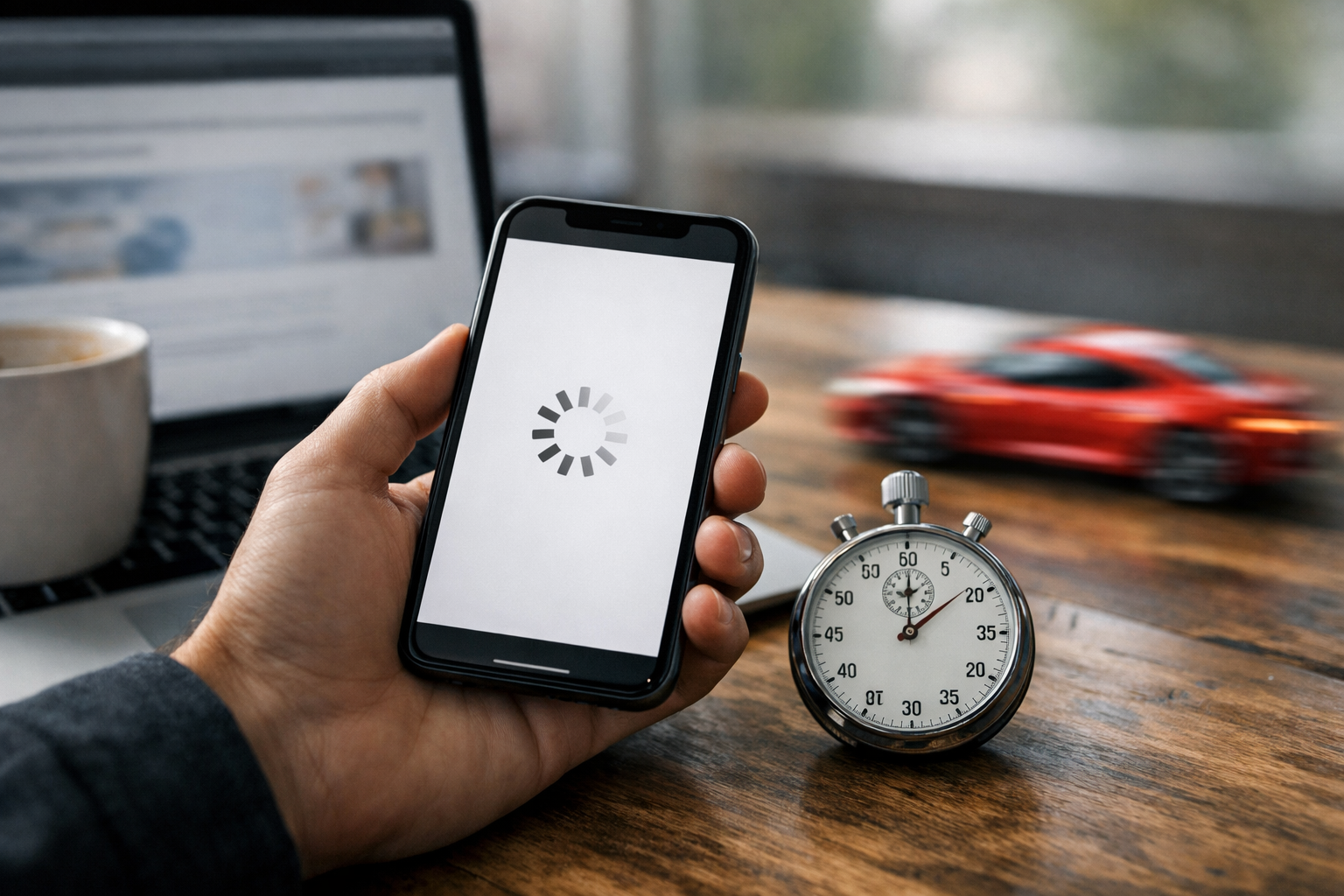
Page load speed has a direct, measurable impact on landing page performance. Research from Google has consistently shown that each additional second of load time increases bounce probability by roughly 30%. For paid campaigns where you’re spending real money to send traffic to the page, slow loading is literally burning your budget.
The biggest culprits on landing pages are usually uncompressed images, unnecessary JavaScript, render-blocking CSS, and third-party tracking scripts that load synchronously. A well-optimised landing page should load in under two seconds on a typical mobile connection. Run yours through Google’s PageSpeed Insights tool and address anything flagged as a major issue before worrying about copy tweaks or design refinements.
Speed is also a trust signal. A fast page feels professional and reliable. A slow page creates an immediate, subconscious impression of a company that doesn’t pay attention to details.
Testing With Purpose, Not for Sport
A/B testing is valuable, but only when it’s structured around meaningful hypotheses. Testing your button in green versus blue is unlikely to produce a significant or lasting improvement. Testing a headline that emphasises cost savings against one that emphasises time savings will teach you something fundamental about what motivates your audience.
Before running any test, articulate the hypothesis clearly: “We believe that visitors from our LinkedIn campaign are more motivated by peer proof than by feature descriptions, so we’re testing a version that leads with customer results against the current version that leads with product capabilities.” That’s a test worth running because the outcome informs decisions beyond this single page.
Statistical significance matters. If your landing page gets 200 visitors a month, you don’t have enough traffic to A/B test meaningful variations. You’re better off making one well-reasoned change, monitoring results over a full month, and iterating based on what you learn. Save multivariate testing for pages with thousands of monthly visitors where you can reach significance within a reasonable timeframe.
The changes most likely to produce large conversion lifts, in our experience, fall into three categories: headline and message match improvements, form simplification, and proof placement restructuring. Start there before testing micro-level elements.
What Happens After the Click
A surprisingly neglected part of landing page performance is the post-conversion experience. What happens immediately after someone fills in your form? If the answer is a generic “Thank you, we’ll be in touch” page, you’re wasting a moment of peak engagement.
The visitor just demonstrated intent. They’re paying attention. Use the thank-you page or confirmation step to set expectations (“You’ll receive an email within 2 minutes with your download link, and one of our team will follow up within one business day”), offer a logical next step (“While you wait, here’s a 3-minute video showing how Company X used this approach to cut their onboarding time in half”), or simply reinforce their decision (“You’re in good company; 340 operations leaders downloaded this guide last quarter”).
The post-conversion step also affects lead quality downstream. If a sales team follows up three days later with no context, the lead has gone cold. If an automated email arrives within minutes, personalised to the offer they requested, with clear next steps, the follow-up call converts at a dramatically higher rate. The landing page doesn’t exist in isolation. It’s one step in a longer sequence, and the transition from that step to the next one matters enormously.
Putting It All Together
A good landing page is not a collection of best practices stapled together. It’s a single, coherent argument that flows from the visitor’s intent through your offer to the action you want them to take. Every element on the page either advances that argument or undermines it; there is no neutral ground.
If you’re building or rebuilding a landing page, start with these questions: Who is arriving on this page, and what do they expect to find? What is the single most compelling reason they should take the action you’re asking for? What would make them hesitate, and how can you address that hesitation before it becomes a reason to leave? Answer those honestly, build the page around those answers, and you’ll outperform the vast majority of landing pages in your market without a single gimmick.