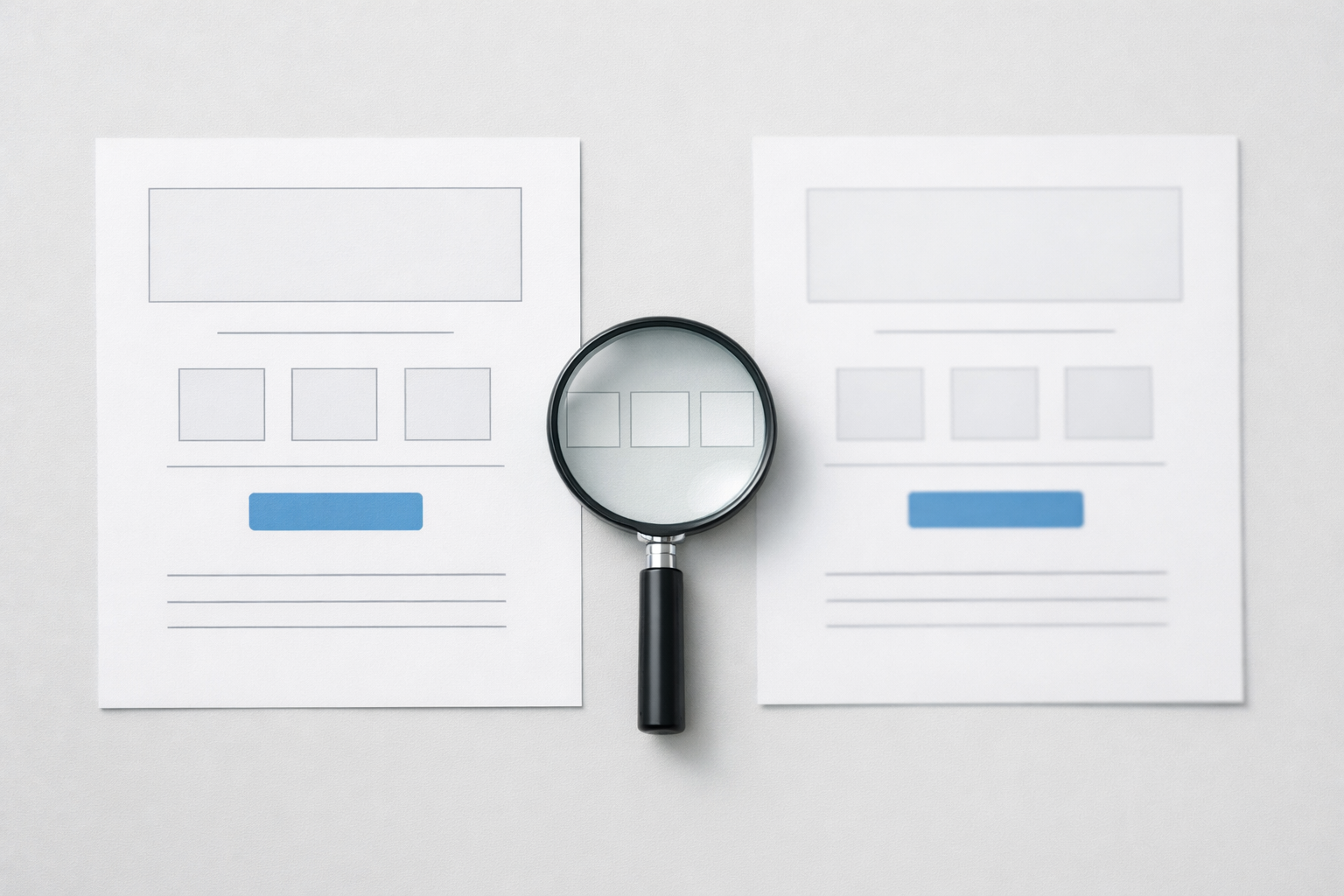

Your Website Probably Has a Conversion Architecture Problem, Not a Traffic Problem
If your website gets a reasonable amount of traffic but produces a disappointing trickle of leads, the issue is almost certainly structural. You don’t need more visitors. You need to fix the mechanisms that are supposed to turn those visitors into enquiries. In our conversion audits at NexusBond, we find that 80% of mid-market B2B websites have the same handful of structural problems, and most of them have nothing to do with how the site looks.
The frustrating part is that these problems are often invisible to the people who built the site or manage it day to day. The homepage looks professional. The copy seems reasonable. There’s a contact form somewhere. But the site isn’t actually engineered to convert. It’s engineered to exist. That distinction is the root cause of almost every lead generation failure we diagnose.
This article walks through the specific, practical reasons your website isn’t converting visitors into leads and what to do about each one. These aren’t abstract theories. They’re the patterns we see repeatedly when we audit sites for companies in the 10 to 250 employee range who are spending money on marketing but not seeing proportionate pipeline results.
You’re Asking Visitors to Do Too Much Thinking
The single most common conversion killer is cognitive overload. When someone lands on your site, they make a series of rapid judgements: Am I in the right place? Do these people solve my problem? What should I do next? If your page doesn’t answer those three questions within about five seconds, the visitor’s attention drifts or they bounce entirely.
Most B2B websites fail this test because they try to say everything at once. The homepage has seven different value propositions, four navigation dropdowns with 30+ links, a rotating banner that cycles through unrelated messages, and a wall of text explaining company history. The visitor’s brain sees all of this as noise. It’s like walking into a shop where every member of staff starts talking to you simultaneously.
The fix is ruthless prioritisation. Every page on your site should have one primary job and one primary action you want the visitor to take. Your homepage’s job might be to establish relevance and route visitors to the right service page. A service page’s job is to build enough confidence for the visitor to make an enquiry. When you try to make one page do five jobs, it does none of them well.
In practice, this means stripping back your pages to a clear hierarchy of information. Lead with the outcome the visitor cares about, not your company’s credentials. Place your primary call to action where it’s visible without scrolling. Remove anything that doesn’t directly support the page’s single conversion goal. This sounds simple, but when we audit sites, we regularly find service pages with three different CTAs pointing to unrelated destinations, which splits the visitor’s attention and tanks conversion rates.
Your Value Proposition Is About You, Not Them
Open your website right now and read the first headline on your homepage. Does it describe what you do, or does it describe the outcome your visitor gets? If it says something like “Award-winning solutions for enterprise technology,” you’ve got a problem. That sentence tells the visitor nothing about whether you can solve their specific challenge.
Effective value propositions are written from the visitor’s perspective. They address the pain, the desired outcome, or the transformation. “We reduce procurement cycle times by 40% for mid-market manufacturers” is infinitely more compelling than “Leading procurement software provider” because it tells the right visitor, immediately, that they’re in the right place.
What we see on most mid-market sites is a kind of corporate hedging. Companies are afraid to be specific because they think they’ll exclude potential customers. The irony is that specificity is what converts. When a visitor who matches your ideal customer profile reads a headline that precisely describes their situation, the psychological response is immediate trust. They think, “These people get it.” Vague, inclusive language triggers the opposite response: “This could be anyone.”
Test this by asking three people who’ve never seen your site to read your homepage for ten seconds and then tell you what you do and who you do it for. If they can’t answer both questions accurately, your value proposition needs rewriting.

You Have No Proof Where It Matters
Trust is not a feeling. It’s a calculation. Visitors are constantly, unconsciously evaluating whether your claims are credible, and they do this by looking for evidence. Proof elements include client logos, case studies, testimonials, data points, certifications, review scores, and media mentions. Most sites have some of these, but they’re almost always in the wrong place.
The typical pattern we see is a single testimonials page buried in the navigation, with three generic quotes that say things like “Great team, highly recommend.” This does almost nothing for conversion because the visitor who’s on your service page, actively weighing whether to get in touch, never sees it. They’re not going to navigate away from the page they’re on to go hunt for social proof.
Proof needs to be placed at the point of decision. That means testimonials and case study snippets should appear on service pages, directly adjacent to the call to action. Client logos should sit near the top of pages where you’re making capability claims. Specific, quantified results should appear in the body of the page, not hidden in a PDF case study.
What Makes Proof Actually Persuasive
Not all proof is equal. A testimonial from “John S., CEO” with no company name, no photo, and no specific outcome is functionally worthless. Compare that to: “Since switching to [your service], our lead response time dropped from 48 hours to under 4. Sarah Chen, Head of Operations, Meridian Group.” The second version is specific, attributable, and outcome-focused, which makes it believable.
The best proof follows a simple formula: who the person is, what their situation was before, what changed, and what the measurable result was. If you can get video testimonials, even short ones filmed on a phone, they outperform written quotes significantly because they’re harder to fabricate and carry emotional weight that text cannot.
We cover the broader mechanics of how proof placement fits into a complete conversion system in our conversion systems guide, which is worth reading if this pattern sounds familiar.
Your Forms Are Friction Machines
If you have a contact form with more than five fields, you are actively suppressing leads. Every additional form field reduces completion rates. This is not a small effect. Research consistently shows that reducing form fields from ten to four can increase submissions by 100% or more.
The reason is psychological as much as practical. A long form signals to the visitor that they’re about to enter a formal, time-consuming process. A short form signals a quick, low-commitment interaction. For most B2B companies, you need a name, an email address, a company name, and a brief description of what they need. Everything else can be gathered in the follow-up conversation.
Beyond field count, consider these common form problems we find during audits:
- The form is only on the contact page. If your service pages don’t have an enquiry mechanism, you’re forcing visitors to navigate away to convert. Many won’t bother.
- The CTA button says “Submit.” This is the least motivating word in web design. “Get Your Free Assessment” or “Book a Call” tells the visitor what they’re getting, not what they’re giving.
- There’s no expectation setting. Visitors want to know what happens after they fill in the form. Will they get a call in an hour? An email within a business day? A 47-page questionnaire? Tell them.
- No confirmation or next step. After submission, visitors see a generic “Thank you” message. A smarter approach is to redirect them to a page that reinforces their decision, perhaps with a case study or a short video explaining the next steps.
The form is the final step in your conversion path. If you’ve done everything right to get a visitor to that point and then the form itself creates hesitation, you’ve wasted all the effort that preceded it.
Your Pages Don’t Have a Logical Flow
Think about the last time you made a significant purchasing decision. You didn’t jump straight from “I have a problem” to “take my money.” You went through a sequence: recognising the problem, understanding the options, evaluating a specific provider, and then deciding to engage. Your web pages need to mirror this psychological sequence.
Most B2B service pages are structured as a random collection of information blocks. There’s a paragraph about the company, then some features, then a testimonial, then pricing, then more features. This layout has no narrative momentum. It doesn’t build towards anything.
A page that converts follows a deliberate structure:
- Open with the visitor’s problem or desired outcome. This creates relevance and keeps them reading.
- Explain your approach and why it works. This builds understanding and differentiates you.
- Provide proof that it works. This builds confidence through evidence.
- Address objections. This removes the barriers to action.
- Present a clear, low-friction next step. This makes it easy to act on the confidence you’ve built.
Each section flows logically into the next, creating a persuasive narrative that guides the visitor toward conversion. When we restructure pages to follow this pattern, we typically see conversion rate improvements of 40% to 150% without changing the traffic source, the design aesthetic, or the fundamental offer.
You’re Treating All Visitors the Same
A first-time visitor who found you through a Google search is in a completely different mental state than someone who’s visited three times, read two blog posts, and just opened your pricing page. Yet most websites present exactly the same experience to both of these people.
Different visitors need different conversion paths. Someone early in their research isn’t ready to “request a demo.” They might, however, download a guide or watch a short explainer video. Someone who’s been researching for weeks and has just landed on your pricing page is signalling strong buying intent and needs a direct path to speak with a human being.
This doesn’t require sophisticated personalisation technology. It requires thoughtful page design that accommodates multiple levels of readiness. On a service page, for example, you might have a primary CTA for a consultation alongside a secondary option to download a relevant resource. The consultation captures high-intent visitors. The download captures earlier-stage visitors who aren’t ready to talk yet but are willing to exchange their email for useful information.
This layered approach means you’re not leaving the early-stage visitors with nothing, and you’re not forcing high-intent visitors to wade through educational content they don’t need. It’s the difference between having one net in the water and having several, each designed for different conditions.

Your Site Loads Too Slowly on Mobile
This one is unglamorous but devastating. If your site takes more than three seconds to load on a mobile device, you’re losing roughly half your mobile visitors before they see a single word of your content. For B2B companies, mobile traffic typically represents 40% to 60% of total visits, and that proportion is growing steadily.
Slow load times are usually caused by uncompressed images, bloated page builders, excessive third-party scripts (chat widgets, analytics tools, tracking pixels), and cheap hosting. The solution is technical but not complicated: compress images, reduce script weight, use a quality hosting provider with server-side caching, and eliminate anything on the page that isn’t earning its keep.
You can check your page speed in Google’s PageSpeed Insights tool. Focus on the mobile score specifically, because that’s where the problems are most acute. A score below 50 is a serious conversion liability. We’ve seen cases where improving mobile load time from five seconds to under two seconds produced a measurable increase in mobile enquiries within the first month, with no other changes to the site.
Your Follow-Up Process Is Killing Warm Leads
Here’s a scenario we encounter more often than you’d expect. A company spends serious money driving traffic. The website actually generates a decent number of form submissions. But the leads go into a shared inbox where they sit for 24 to 48 hours before someone responds. By that point, the visitor has contacted two competitors, one of whom replied within 15 minutes and already scheduled a call.
Speed of response is one of the most powerful conversion factors in B2B, and it has nothing to do with your website’s design. Research from multiple studies consistently shows that leads contacted within five minutes of submitting a form are dramatically more likely to convert than those contacted even 30 minutes later. The effect is not linear; it drops off a cliff.
Your website’s job doesn’t end at the form submission. The immediate post-submission experience matters enormously. Set up automated email confirmation that arrives instantly, sets expectations for next steps, and reinforces the visitor’s decision. Route form submissions to a dedicated channel with notifications. Measure your average response time and treat it as a key metric, because a beautiful website with a 36-hour response time is leaving money on the table that no amount of design polish will recover.
You Haven’t Defined What a Conversion Actually Is
This might seem obvious, but a surprising number of companies can’t clearly articulate what they want website visitors to do. “Get in touch” is not a conversion strategy. A defined conversion is a specific, measurable action that moves a visitor into your sales process.
For some companies, the primary conversion is a consultation booking. For others, it’s a quote request, a demo sign-up, or a gated resource download. The critical thing is that you’ve chosen one primary conversion action per page and built the entire page around driving that action.
When there’s no clear definition, the website ends up with a scattershot approach. Some pages have no CTA at all. Others have three competing ones. Nobody is tracking which pages produce leads and which are dead ends. There’s no way to systematically improve conversion because there’s nothing specific to measure.
Start by mapping your website’s pages and assigning each one a primary conversion goal and a secondary conversion goal. Then check whether each page actually has the elements needed to achieve those goals: a clear value proposition, relevant proof, an appropriate CTA, and a logical flow that builds toward the action. Pages that lack these elements are, functionally, decoration. They might satisfy your ego, but they’re not generating revenue.
What to Do Next
If you’ve read through this list and recognised your own website in several of these patterns, the good news is that these problems are fixable, often without a full redesign. The highest-impact starting point is usually your top three to five pages by traffic volume. Pull up your analytics, identify which pages get the most visits, and audit each one against the criteria above. Is the value proposition specific and visitor-focused? Is there proof at the point of decision? Is there a single, clear conversion action with minimal friction? Does the page follow a logical persuasive sequence?
Fix those pages first. Measure the results over 30 to 60 days. Then move to the next tier. This iterative, evidence-based approach produces far better results than a sweeping redesign because it lets you isolate what’s working, learn from the data, and compound improvements over time. The websites that consistently generate leads aren’t the prettiest or the most expensive. They’re the ones where every page has a clear job, the right proof in the right place, and a frictionless path from interest to action.